 Audio Tag Editor
 BPM Finder
 Live BPM Finder
 Key Finder
 Mix Maker
 Track Analyzer
 Transition Finder
 VST Manager
The question usually comes up the same way. You're reading about DJ prep, someone mentions harmonic mixing, and Mixed In Key gets recommended like it's mandatory. You check the price: $58. Then you find a dedicated BPM app for $6.99. Both claim to analyze your tracks. The feature lists are different enough to be confusing, and you're left wondering whether the 8x price gap reflects genuine value or whether you'd be paying for things your DJ software already handles.
That last part is the question most comparisons skip. Key detection is now built into Rekordbox, Serato, Traktor, and most major DJ platforms. That changes what Mixed In Key is actually competing against. Here is an honest breakdown of both tools, who each one is for, and the cases where spending more, or less, is the right call.
At a glance
The apps
BPM Finder
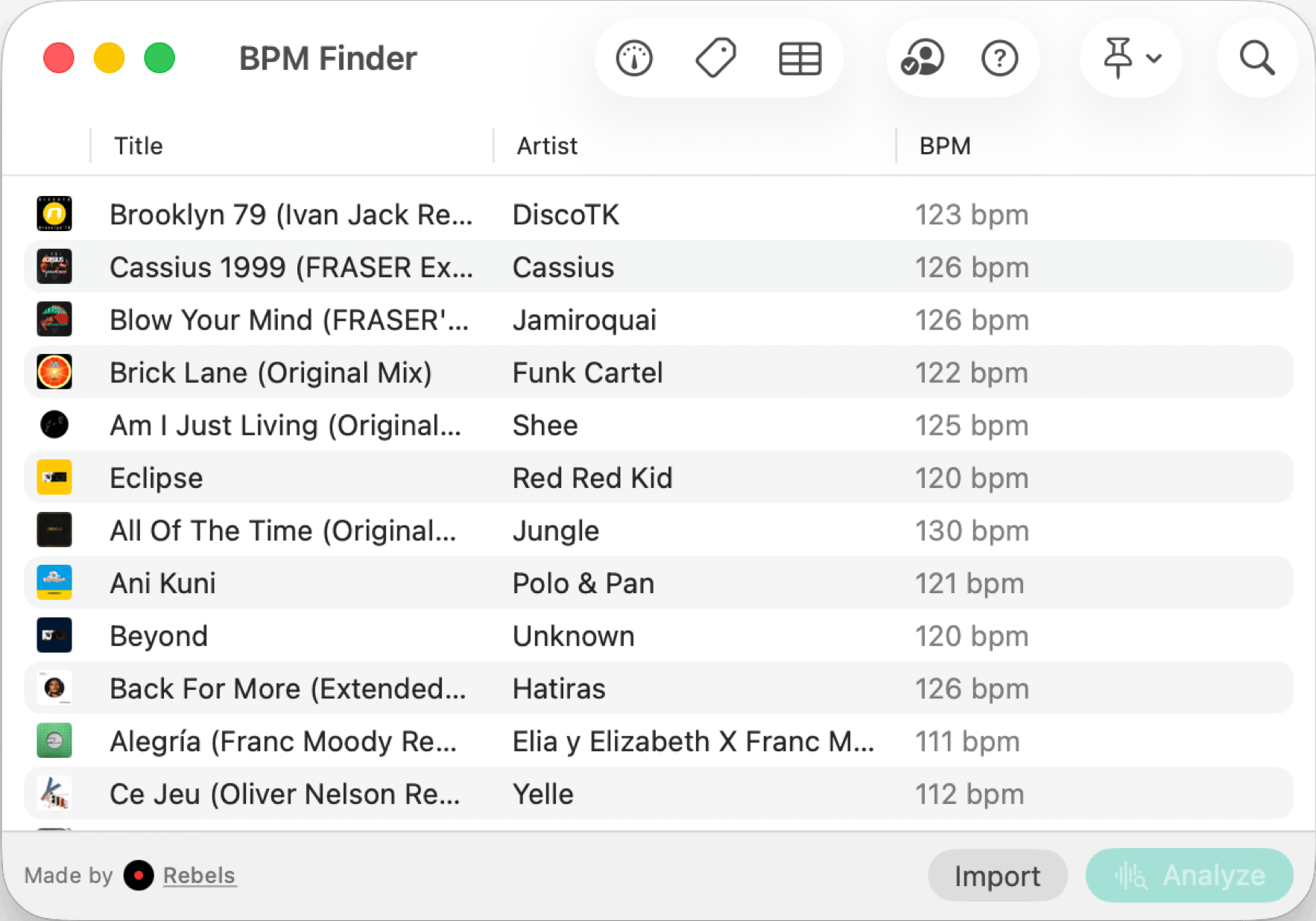
BPM Finder is built around a single premise: get accurate BPM data into your files as fast as possible, with no overhead. Drop in one track or an entire folder. Detection runs entirely on-device in under a second per track, with no account, no internet connection, and no audio leaving your machine. When the batch is done, the app can write the result directly into each file's metadata, so every piece of DJ software you open afterward sees the correct number immediately.
The $6.99 covers Mac, iPhone, and iPad under a single App Store purchase. If you're checking BPM on your phone mid-crate-dig, or running a batch analysis on a MacBook before a gig, it's the same app. Batch mode processes libraries of hundreds of tracks with low CPU usage, running quietly in the background.
The limitation is honest and intentional: it only detects BPM. No key detection, no Camelot codes, no energy levels. If harmonic mixing prep is part of your workflow and you want all of that in a single pass from one tool, BPM Finder handles one part of that equation, not the whole thing.
DJs who need fast, accurate, offline BPM detection across Mac, iPhone, and iPad, with results written directly to file metadata.
Mixed In Key 11
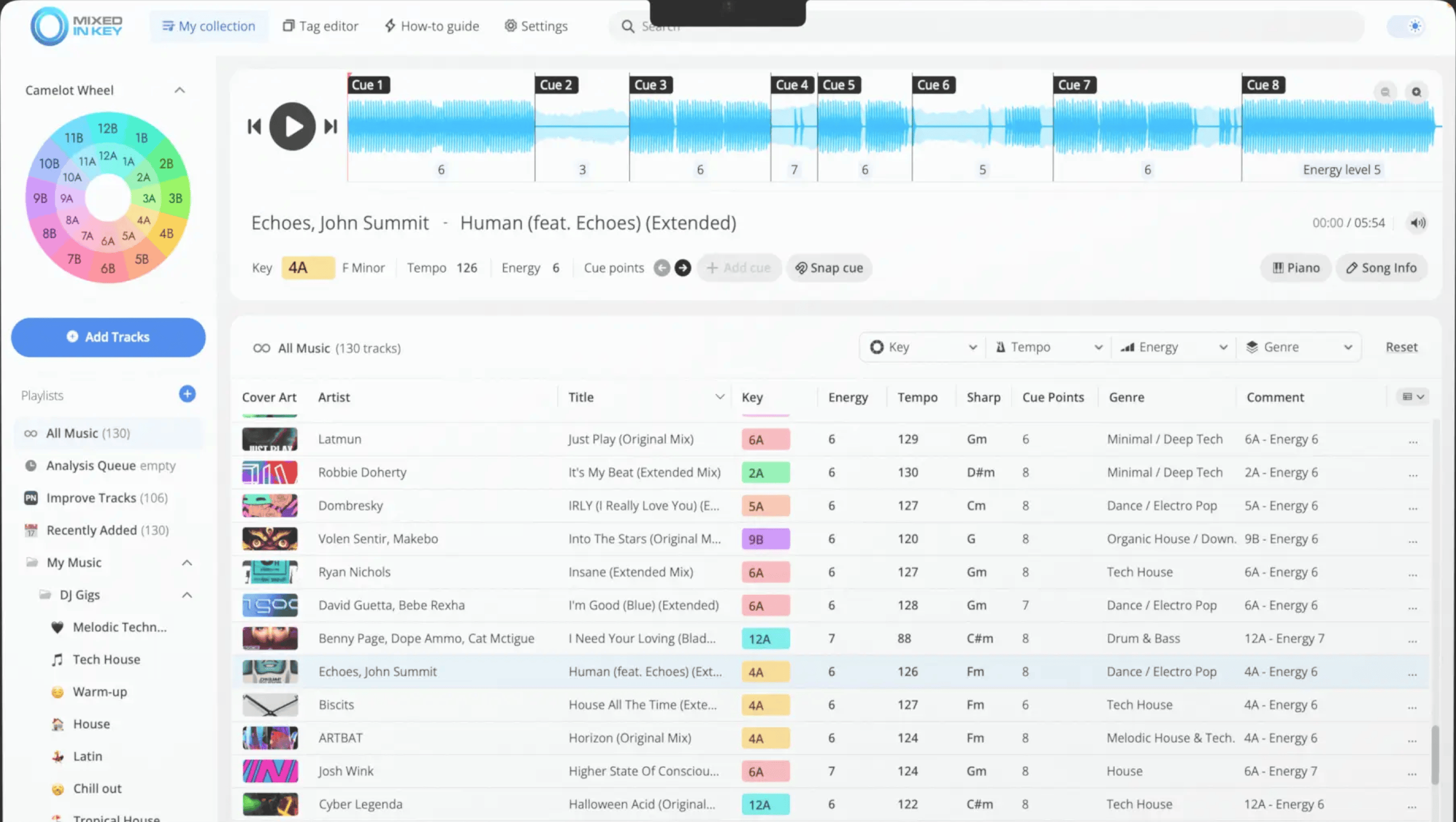
Mixed In Key 11 has been the reference for harmonic mixing prep since 2006. Key detection accuracy is excellent, the Camelot wheel system it helped popularize is still the standard language DJs use for harmonic compatibility, and the energy level ratings give you a genuine signal for managing set energy over time. Automatic cue points and batch processing are also included. If you want BPM, key, Camelot code, energy level, and cue points written to your entire library in a single pass, this is still the most complete tool that does it.
The honest question to ask before buying is whether you already have part of this covered. Rekordbox, Serato, and Traktor all include key detection now, and most DJs prepping in those platforms are getting Camelot codes written automatically without any third-party tool. If key detection is already running in your DJ software and you're actually using it, the core argument for Mixed In Key is weaker than it was five years ago. What you'd be paying for is accuracy (which some DJs find meaningfully better than in-platform analysis), energy levels, and cue point detection. Genuinely useful features, but optional ones depending on your workflow.
One thing worth knowing about the product line: Mixed In Key 11 Pro exists at $99 and is a substantially different product. It adds a Mashup mode, DJ Mix mode, stem separation, and real-time transition suggestions. If creative set prep and mashup building are your goals, it's worth looking at separately. For the standard BPM-and-key library analysis question, version 11 at $58 is the relevant product.
Mixed In Key distributes directly from its website, not through the Mac App Store. There is no iPhone or iPad version.
DJs building harmonic sets who want BPM, key, Camelot codes, and energy levels handled in a single pass, and who are not already using key detection inside their DJ software.
Which one should you get?
If BPM is all you need, the answer is short. BPM Finder is accurate, offline, fast, and $6.99 covering three platforms. There is no version of that use case where $58 more is rational.
If you are building harmonic sets, the question becomes more specific: are you already getting key detection from your DJ software, and are you actually using it? If yes, Mixed In Key's primary value proposition is already covered in your setup. The upgrade it offers is better accuracy, energy levels, and cue point detection, worth having, but not a requirement for everyone. If you are not using a platform with built-in key detection, or you want the analysis done independently before import so every tool you use sees consistent data, Mixed In Key earns its price clearly.
My honest take: I use BPM Finder for tempo and pair it with Key Finder for harmonic prep (or Track Analyzer in one pack). Two focused tools, both offline, both covering Mac, iPhone and iPad, total cost under $15. Mixed In Key makes sense when you want everything in one interface and you are not already getting key analysis from your DJ platform. But "everyone recommends it" is not a reason to pay $58 if your actual need is narrower than what it does.